Showing posts with label architecture. Show all posts

Saturday, 11 January 2014

Goodbye to Auld Yonge Street


You don't have to travel to Detroit to photograph images of people living in dilapidated and collapsing buildings. You can find the same thing in Toronto!

On Canada Day 2013 I journeyed to the former North York area of the city of Toronto to document for the last time a stretch of 2 story postwar retail buildings. Due to development pressures, these buildings will be demolished and Condos will rise in their place.


Click to enlarge- it's worth it

The journey begins with this cute cluster of buildings that have not only survived, but are thriving.

Sapporo Sushi/ Academy of Excellence- 5469-Yonge St, North York, ON
Click to enlarge- it's worth it

I've heard they make good sushi!

Laneway at rear of 5469-5437-Yonge St, North York, ON
Click to enlarge- it's worth it

For the true urban romantic (psychogeographer, as Guy Debord would have said), a dirt laneway in such a metropolitan location presents great charm.

Mister Transmission- 5437 Yonge Street, North York, ON
Click to enlarge- it's worth it

I was drawn to this building for reasons I cannot fathom. I think partly because of the precise calibration of its dereliction... That perfectly-centered missing decor panel. The fact that a building that is going to be torn down is getting a new roof?!

It's been up for sale for over one year.

Future Condo Complex- 4917-4975 Yonge Street, North York, ON
Click to enlarge- it's worth it

Stewart Brand writes that over time, buildings learn. I would say this building has learned it's going to die. Slowly. The Conservancy Group has applied to build a complex that includes the Platinum Tower, Platinum XO, and Pearl Residences. According to Urban Toronto it has been in limbo since Jan 2009 as the developer applies for different zoning variations.


Riviera Travel Agency-5376 Yonge St, North York, ON
Click to enlarge- it's worth it

The Riviera Travel Agency is the jewel that motivated my excursion in the first place. It's such an optimistic streetfront. The beautiful typography of the signage. The obsolete logos. Vitrolite tile!

And yet that aged and decrepit roof indicates the building is being neglected..

Click to enlarge- it's worth it

Flickr member “John Fitzgerald in Toronto” had this to say about Riviera travel...
"I love the top sign. Some classic 50s-style calligraphy and some nice old fonts. I'd guess the sign is from the late 60s or early 70s, though, because the blue trim at the bottom is more characteristic of that period than of the 50s. An interesting transitional piece, as we say the Design Critics' Union meetings."


Click to enlarge- it's worth it


How this area looked in April 1955...

Future Ellie Condo Complex- 5220 Yonge Street, North York, ON
Click to enlarge- it's worth it

This building was originally the North York & Weston Family Service Center. Now it's going to be the Ellie condo complex. I hope families in need still have a support organization.

Closed - 5015 Yonge St, North York, ON

The building is sloughing into a rather beautiful ruin. It's sure to be an eyesore for years to come, as no re-development plan has yet been filed with the City.

Vic-Tone Dry Cleaners- 4866 Yonge St, North York, ON
Click to enlarge- it's worth it


And we end our tour admiring a lovely sign at a classic 20th Century storefront, still surviving in the 21st Century.

Wednesday, 29 August 2012

Brutalist Bunker in Board-and-Batten

Ask any local and they'll tell you that the colonial townsite of Niagara-on-the-Lake "has charm coming out of its arse". The most historic part of what was once Upper Canada, there have been buildings on this site for two hundred years. So naturally as soon as I arrived in town I had to do a survey of the town's architecture. Ignoring the colonial, I went straight for the late modern, of course.

First up, the acknowledged masterpiece of Ron Thom's 1973 Festival Theater. According to the website Ron Thom House for Sale - "Thom liked to set his buildings so that people could come across a house in the trees – from above or below – but not be able to see all of it. A low-hipped cedar shake roof floats over the cedar and cement block base. Glass meets glass and corner windows vanish into thin air. The house reflects Ron Thom’s admiration for the designs of both Frank Lloyd Wright, and Richard Neutra."

Although Thom's idiom is nominally west coast (think Arthur Erickson) his execution at Shaw has more in common with Soviet Block Eastmodern.
Hiding in shame


Look ma, no windows
Well guess what. Thom didn't design some west coast cedar gem nestled into a hillside. Thom plunked down a late modern brick pile, all planes and geometry and completely absent glass meets glass. With absolutely nothing of human scale to the place, Thom's Festival Theater shows an insular cultural insensitivity that's remarkable for a town that has only one business- staging early modern plays!
Welcome humans - sorry there's no windows. Or door.


The only inviting vista - entering via the rear

At almost the other end of Queen Street is another inexplicable intersecting planes piece of Trudeau-era optimism - the Canada Post outlet. It's not merely insensitive to the 200 year old buildings that surround it. It reminds us that the Feds do what they want, where they want. No municipal ordinance holds sway for them. This charming institution even has a name - Property Number:61768. And its own website.


No shame

Speaking of own website, here's the Campbell Scott house. Campbell was an early cultural influence on me – he taught me woodworking (along with a generation of students at St Catharines Collegiate Institute and Vocational School). It's sad to know he has recently passed away (February, 2016).


I've saved the best for last. Some clever Johnny or Joan managed to sit at a drafting table and foist a Brutal School Bandshell on the governors of Simcoe Park. This foreboding silhouette "illustrates typical Brutalist characteristics such as top-heavy massing and the appearance of a bunker-like structure."


To me it's too funny. Usually a brutalist building is concrete gravured with the texture of the wood forms in which it was cast. Here, they just nailed together the wood form. Way to cut out the middleman.


A flying apron?!

Up next - Post Modernism in Colonial Williamsburg.

Friday, 3 August 2012

Stairwell

Minimalist exploration of mid-century urban architecture. My feet, walking down a stairwell. Companion piece "Hallway".

2nd logical iteration is women's high heels. Convo me if you want to collaborate.


Hallway

Minimalist exploration of mid-century urban architecture. My feet, walking in a hallway. Companion piece "Stairwell".

2nd logical iteration is women's high heels. Convo me if you want to collaborate.


Sunday, 15 July 2012

The Trillium Building


A generic mid-century high rise residential apartment building located in East York near Woodbine and O'Connor. Displaying some very classic Googie-like adornments including a Porte-Cochere full of wholes.

Videography by Alan Fox. Soundtrack "Blip Bounce feat. Philter Fox"


Wednesday, 11 July 2012

Art-Streamline-Deco-Moderne

Nothing provides more torment for the strolling urbanite than correctly classifying architecture dans le mode Arts Decoratifs. Because, quite frankly that Art Deco building you pass every day almost certainly is not Art Deco.

First, and most obviously, because Art Deco dates from les Exposition internationale des arts décoratifs, April to October 1925. Yet the term Art Deco is not coined until 1960. Art Deco was an exhibition, not a school. Thus it has become conflated with the contemporary and formal architectural schools of, say, The Bauhaus in Germany and De Stijl in the Netherlands.

Also since we are talking about the city of Toronto, we could not be farther away from the European capitals where Art Deco was practiced.

Finally, Art Deco was never about architecture. Art Deco is about household decoration. The primary Art Deco object is a cocktail shaker. In an Art Deco cocktail cabinet.

Then there is the practical business that in the period 1914 to 1939 the world was:
  • Twice at war
  • In a recession
  • Traveling by steamer

The totality of these conflated realities is that there were almost no chances for wealthy American property developers to:
  • Become exposed to the ideas of Art Deco
  • Find expert architects to design Art Deco skyscrapers
  • Have sufficient funds in the bank to build Art Deco skyscrapers
  • Have a sufficient labor force to mobilize to build their chic and modern tributes to their own inner Croesus

Thus it is with confidence I state that your favorite Art Deco building might be Art Moderne. It might even be Streamline Moderne. But it is NOT Art Deco.

Let us use this humble borough war memorial to function as our Rosetta Stone and provide the codex of Art-Streamline-Deco-Moderne.
What do we see?
  • Clean lines
  • A trapezoid shape
  • Limestone
  • Corners without fillet or radius curve
  • Period font
  • Only one obscure glyph - the memorial wreath
  • Korean War -1950s

And directly across the street is this superb Streamline Moderne masterpiece - Toronto East General Hospital, circa 1949...
"Fox, you ask - Why Streamline Moderne and not Art Moderne?". Good question. Those horizontal speedlines are among the most characteristic design element of Streamline Moderne. To qualify in this category, something on the building must look like it's going fast

Sadly, here is a cute little Art Moderne cottage right next door to the hospital. With a callous application of siding and brick veneer her perfect lines have been completely destroyed...


Finally, here is a real Art Deco building, Hamilton's 1930 Toronto, Hamilton & Buffalo passenger train station...
copyleft Wikimedia Commons


And finally, another look at that beautiful Art Deco building that has been destroyed in the 21st century

Tuesday, 10 July 2012

Not a run-of-the-mill mill

Late last century I lived in east Toronto Danforth. I developed a special appreciation for this area. Unlike the overdeveloped downtown Toronto, where the past has been descecrated, east Danforth contains many historic structures that may have been adapted but are still evidently time travellers.

Perhaps none captures this more than 10 Dawes Road. According to Melanie Milanich, in "Dawes Road: a Shortcut to the Market and a Natural Resource Base" 10 Dawes Road was "A steam powered grist mill, built in the 1890s and originally called
Chalmer's Flour Mill..."

In 2009-2010 local business directories cited 10 Dawes Road as the property of Elizabeth Feed Co.

Click to enlarge


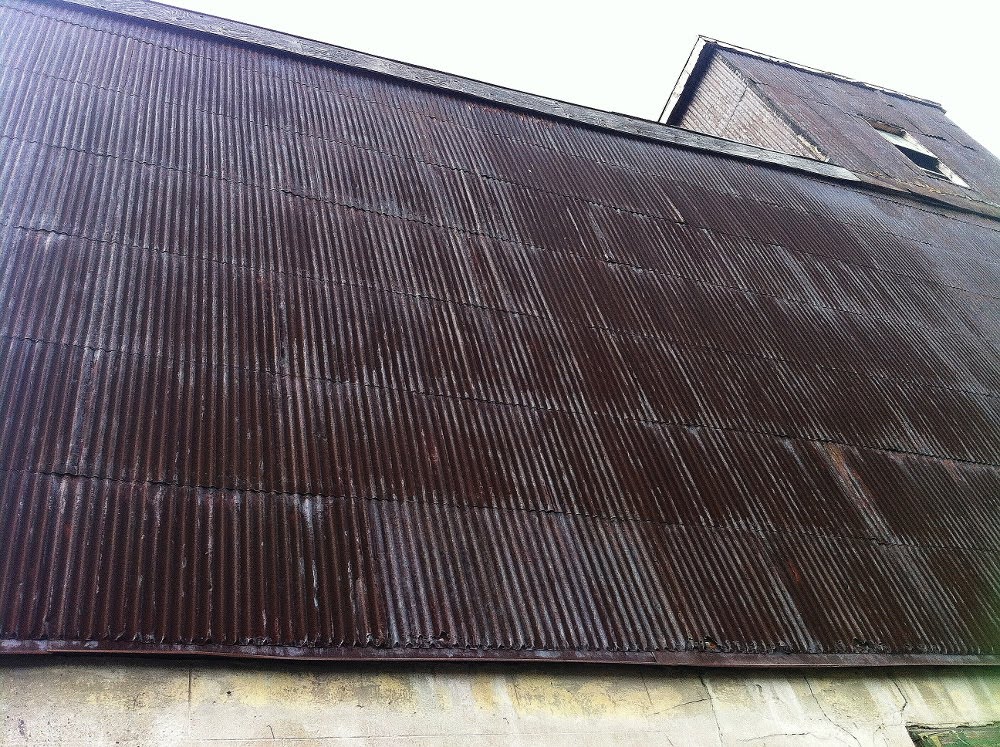
Normally I provide a detailed and erudite commentary that interprets the artefact for you. In this case I am not going to. Look at this building and trust your instincts. That cast cement base is clearly mid-late 19th century (that is, 1850-1880). All that corrugated sheet metal superstructure is clearly cladding covering a wooden mill that needed a new layer of protection. That headhouse on the top story is clearly where the works of an elevator are housed.

And there is NO WAY this is a steam mill. Where is the powerhouse? Where is the hundred foot smokestack?


Not entirely good news. Those lovely new french doors mark the commencement of the next renovation. One I predict will end with the structure transformed, re-clad, and unrecognizable.


We carry complete lines for
racing pigeons, budgies
and other birds
Best mixtures available
Race horses, dogs,
all other animals
Grits, Gravels, Flax


I have met with the owner and hope to have interior shots before the year-end.

Monday, 9 July 2012

Update: Art Deco Gem - 103 Church Street

Update: The main floor tenant Golden Thai Restaurant has closed after 20 years 


There has sat at the corner of Church and Richmond a tiny perfect Art Deco masterpiece for four score and two years! The 1930 J. Frank Raw Building is one of the platonic ideal of Arts Decoratif movement. It's all here- the limestone finish, the font-astic typography of her numberboard, the Egyptian ziggurat setbacks (absolutely essential for period), the octagonal windows, the mullioned windows... even the curve of streetcar track is perfect and to period.


And, most significantly, it has been well maintained. Many of its peers have been "improved", typically by adding a 50 story modernist tower on three sides of them. Or carving them out into a cheapjack theatre, like the conversion of the TSE into "The Design Exchange".


The Art Deco Society officially records the building as the 1932 Charles Dolphin Building. Given that Dolphin's masterpiece was the 1941 Postal Delivery Building now called "The Air Canada Centre" it is an impressive pedigree for this building.

And here is what happens to Art Deco buildings when they are not maintained properly.


Thursday, 3 May 2012

Queen's Park's Whitney Block Tower


The Whitney Block Tower is a Modern Gothic structure added in 1932 to architect F. R. Heakes 1928 Whitney Block. It is faced with Queenston limestone. Due to the building being situated on the street racing part of Queen's Park Crescent most people take no heed of it.

As first built it was an eclectric complex for a Provincial Government headquarters, featuring
  • a bowling alley in the basement
  • An early form of conditioning that used blocks of ice
  • The sixth floor contained animal pens used by the provincial veterinary services that were housed there. Cows were brought up to the lab in an adjacent service elevator.
  • The elevator is not automated but has to be hand cranked
As imposing as the Whitney Block tower is, it is an abandoned building.

The building hasn't been inhabited since 1968, when it was deemed a fire hazard. There is only one staircase, which makes it unsafe in the event of an emergency evacuation. As well, there is no central mechanical ventilation system. The only way to get fresh air into the building is by opening the windows.


Tuesday, 27 March 2012

Of Mies and Mien

Just before my illness I was on secondment in Minneapolis-St Paul [MSP], a ridiculous long moniker for a city that we in Canada would just call Welland. Arriving in Downtown MSP the first thing you notice is that there are NO buildings in the International Style. This immediately tells you that from sometime in the 1950s until the 1990s the town was in decline. Even my home town of St Catharines [Pop 280,000] has a building representing that period.

Today's Google Doodle celebrates the greatest International Style architect of all time, Ludwig Mies van der Rohe. Mies to his friends. Le Corbusier is a vastly superior visionary, but he never built anything, so that rules him out. Philip Johnson comes close, but his primary contribution is that he moved the International Style into Post Modernism

A little known fact about Mies is that he never lived in his own buildings. For living he adored luxurious fin de siècle 19th Century architecture, so he lived more like Jules Verne than George Jetson, whilst designing buildings whose vernacular is still as fresh as the latest pop song.

Mies has more than a few Canadian connections. Phyllis Lambert, the Bronfman heir, gave Mies his greatest commission in the Seagram Building in Manhattan.

The Toronto Dominion Centre is essentially a clone of that project. Although it is gradually being eroded. The shopping Mezzanine has been destroyed by renovations. However Shawn Micallef tantalizingly informs us there's a Mies van der Rohe-designed Cinema mothballed somewhere in that complex.

My favorite, and the gem I save for last, is that he designed an Esso Station in a suburb of Montreal. This is an almost inconceivable marvel. Imagine a Daniel Liesbkind Chrystal Harvey's in Newmarket. No, really, that's what we're talking about. A purely functional building for a chain franchise in an unremarkable place. Designed and built by the greatest architect of his time at the height of his powers.

Needless to say the owners attempted to demolish it in 2008. Fortunately it was built somewhere French, where culture is air, and the community refused to demolish, somehow acquired it, and it is now a community centre.

Mise à jour - La Station: bâtiment public intergénérationnel